By con@concept-pl.us in
on October 27th, 2019
An installation by Danae Stratou, 2000
“…Deep within the ground there are caverns and tunnels and ways for the sacred energy to travel. Earth inhales and exhales just as we do; sacred life energy moves within her body as it does in ours…”
Hopi Indians
This work was originally installed and shown at an old warehouse in Athens, near the docks of Piraeus harbor. This is a very interesting, industrial area, which is a natural junction between the city and the sea. The space was left untouched, old and dilapidated as it was. Upon entering the installation’s space, the viewer is enveloped by the scent of earth as he physically walks upon the rich layer of reddish earth that covers the entire space. At the center of the space, a round pool of light attracts the viewer to approach. The gentle esoteric sounds of breathing and the subtle rhythmic movement of the earth itself furthers the magnetic pull on the viewer’s senses creating an active involvement, as all of the senses are evoked. At the installation’s centre, inanimate earth was energized and given movement. The breathing motion “expands” and energizes the whole space. The sounds are echoes of the primal act of breathing. This work seeks to motivate the synergy between the intellectual and the emotive realms thus evoking the physical recollection of the ‘memory-experience’ of a primeval relationship to the world.
Breathe has been presented in the following exhibitions:
2000
BREATHE & WATER SECTION | Solo exhibition | Sarantopoulos Flour-Mills, (Athens – Greece). Curated by Efi Strousa
2001
1st Bienal de Valencia 2001 | Passions. Main exhibtion Boby and Sin, (Valencia, Spain). Curator Achille Bonito Oliva.
Christie’s Contemporary (Athens, Greece). Curated by Elisavet Lyra.
By con@concept-pl.us in
on October 27th, 2019
A new version of The Globalising Wall video installation with an original composition by Ada Pitsou.
By con@concept-pl.us in
on October 27th, 2019
By Makis Faros, 2009
The project is based on the poem of Wallace Stevens titled “LEBENSWEISHEITSPIELEREI”
The lyrics : “The proud and the strong Have departed” marks a huge portion of the history of the African states calling for their independency at the decades of 60 and after. People who were cut off from their land, used to be dependent on slave labor and within a culture imposed on them, had to stay stool when their invaders departed. These mechanisms can also be found at the contemporary consumer societies of the western world. The video focuses on the endless vicious game of them: those who remain, between desire and the “grandeur of annihilation”
By con@concept-pl.us in
on October 27th, 2019
A project by Mari Velonaki, 2010–11
Copper structure with integrated mirror, incandescent light globes, hydrophones, electronics and computer for real-time sound manipulation, water and electricity. Dimensions 220 cm x 120 cm x 36 cm.
A work about symbiotic relationship between heterogeneous elements, which is a recurrent theme in my work.
A copper structure that houses a full-length mirror is placed against a gallery wall. A row of six round incandescent globes crown the top of the mirror. The globes are brightly lit. As a spectator approaches the mirror for a closer look, s/he sees drops and rivulets of water trickling down from the electrified globes, with droplets falling to the surface of a water-filled tank embedded in the base of the copper structure. The droplets generate a continuous and ever-changing soundscape as they fall and splash into the water. Metallic resonances ring throughout the space in counterpoint with ‘bassy’ undertones, renewed with every droplet. By extending their hands, visitors can catch lukewarm droplets landing on their palms—at the same time they actively influence and can even still the soundscape.
In this reactive installation, I aim to create a reflective state of attraction and uncertainty. The work mirrors both the current state of global affairs and the space of personal reflection and contemplation. In this work the re-circulating water which is drawn from the open water tank and pumped to the top of the mirror construction only to fall as droplets references the earth’s water cycle; a natural cycle that has been disrupted through industrialisation with the accompanying threat of global warming and sea level rises. The light that illuminates both the water and the mirror is provided by incandescent globes; globes that have been made obsolete in many countries around the world in an effort to reduce urban energy consumption. The globes are powered by electricity which also powers the re-circulating water as it travels over the globes and falls to generate an ever-changing soundscape. The work suggests a symbolic symbiosis between heterogeneous elements that can coexist within a utopian ‘recycled’ unity.
Current State of Affairs meanders between ‘neo-retro science fiction’ and the industrial revolution, linking ‘ways of being’ to contemporary ecological sensitivities in relation to urban environment and consumption by creating a regenerative water cycle. Unnatural in an industrial sense, water and electricity indicate a surreal state, with a certain seductiveness in the aural outcomes produced by the unusual encounter of these two elements; a reflective structure that at once invites and repels with its promise of a futuristic wishing-well.
When I first envisaged this project I was inspired by a specific site: the old Electrical Store at Cockatoo Island in Sydney Harbour—a site that in my eyes resembles a gigantic factory rather than a ‘store’. Cockatoo Island has been at various times a prison for convicts, a site for ship repair, and was at one time the largest shipyard in Australia. The shipyard was closed in the early nineties, and the site is being revitalised for reuse for exhibitions and other cultural events.
The work does not pretend to propose a solution to the general public for the urban excesses of energy consumption, but to draw their attention to this problem by creating an utopian system that reuses and regenerates post-industrial artefacts to create, aurally and visually, a new aesthetic framework.
Technical Approach
For safety reasons the globes are not powered by 110V mains electricity, but at the intrinsically safe level of 32V. Water is pumped from an open tank in the base of the mirror structure to a distribution plenum at the top of the structure. Pressure regulation and needle valves allow adjustment of the water flow over individual globes. Six hydrophones capture and amplify the sound of individual water drops as they strike the surface of the water in the tank. The sound is filtered and manipulated by computer software in real time. The work is in two parts: the mirror structure itself, plus a small rack-mount box that contains power supplies, preamplifiers and the computer.
By con@concept-pl.us in
on October 27th, 2019
Video by Yioula Hatzigeorgiou, 2010
Using simple technical means and the most natural materials, Yioula Hadjigeorgiou is able to transform the tangible, everyday reality into a poetic action. With references to history, she tightly bonds the personal with the universal in a continuous motion of memory and self-knowledge. In her recent works, she symbolically uses ash as her raw material. Being the result of deconstruction and destruction, linked with mourning and death, ash becomes both a structural material for making bricks and a purification powder – like in an ancient tragedy. In her latest work in progress “Bypass”, ash is used in a thick layer in an installation on a table, where it is moved with a simple, invisible “magical mechanism”, creating an amazing poetic and at the same time a mourning result. The ash, which suddenly comes to life with motion, creates imaginary, utopian mappings of a dreamlike landscape and is linked with such concepts as rebirth and the recycling of death into life. The short video which records part of this continuous circular movement of the ash – a material that the viewer does not readily recognise – creates an unprecedented depiction of reality. The artist replaces the concepts of separation and borders with the open structure of the moving ash, an alternative image to the impasse of mourning. The continuous change of this visual landscape functions figuratively as a reconstruction of the ego identity, which is absolutely necessary and not just on a personal level. Hadjigeorgiou points out that “if people do not want to be buried in a mausoleum, they need to know how to get rid of their habits, to tread on them in order to renew themselves.”1
The poetics of the transformation and the continuous movement of the ash come in stark contrast with the poetics of the absurd, which are to be found in the heart of the video “Knife in water”. With a repetitive movement, the artist cuts, slices the water – a metaphor of history and the wounded memory of Cyprus – thus strengthening the sense of absence and mourning, of the desperate fruitless attempt in the middle of the void.
1. Thoughts of the artist in a discussion with Andri Michael [April 2012].
By con@concept-pl.us in
on October 27th, 2019
A photographic project by Dorotea Mercuri, Kerameikos, Athens, Greece (2012-13)
Athens Stories is a project born from my view on a city and a society living through a drastic time of change. Street art takes a vital place in the most popular areas of downtown Athens, the historical centre. Here life does not stop. Through colours and messages that sometimes can even be painful, the streets became one with the people who have been subjected to the crisis.
Realising that everything must now be told, and as nobody was heard and no one has listened, the walls are playing a crucial role in the expression of this historic time and its scars that none of us will ever forget.
Here are some photos I feel portray everyday life in Athens. The city we love, The city we see struggle and in pain but is still happy when she wants to forget.
By con@concept-pl.us in
on October 27th, 2019
SMS (Save My Soul) expresses the fear and awe of modern realities and a wish for a return to things being simply horrifying and unknown as in the distant past. SMS is a plea, a cry. The neighborhoods, the streets, the power of aesthetics, the factory school, security, private exile, the need for flight by any means, the distorted search for the self, everything as medicine, everything as opportunity, eveything amazing, everything nascent.. Harsh but at the same time poetic and atmospheric music. SMS is This Fluid’s fifth album.
Spyros Faros: sequencers, guitar, voice on (04,08,10) and lyrics on (04,10)
Makis Faros: additional/sequencers, synths, percussions, voice on (04),indian/voice on (10)
Housework: guitar, melodica, wistles, vocals and lyrics on (01,02,03,05,06,07,11,12,13)
With:
Olia Farou: Voice on (09,10)
Anna Tirigi: lyrics on 08
Yianna Kafe: cries, sighs, breathings on (08)
Mari Masouridou: Photos,videos and visuals
By con@concept-pl.us in
on October 27th, 2019
An ongoing project by Maaike Stutterheim
Relevant links:
www.maaikestutterheim.nl
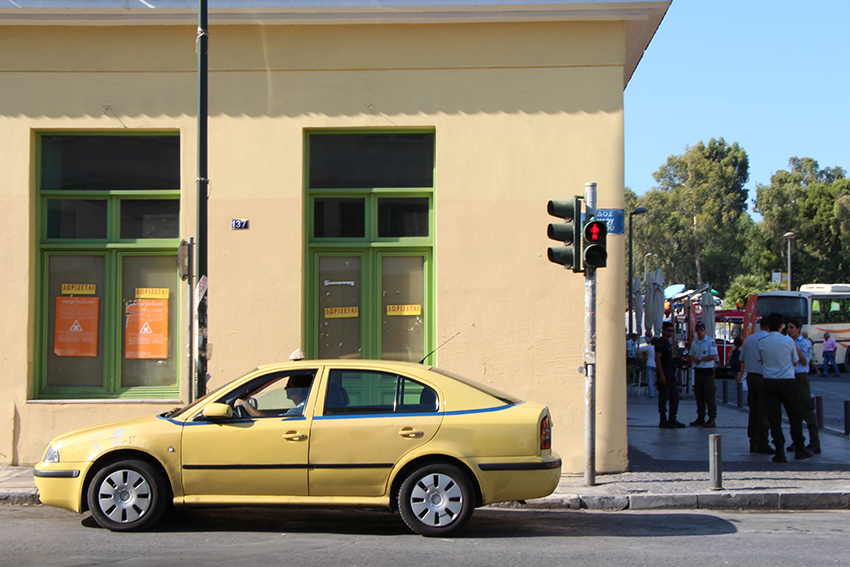
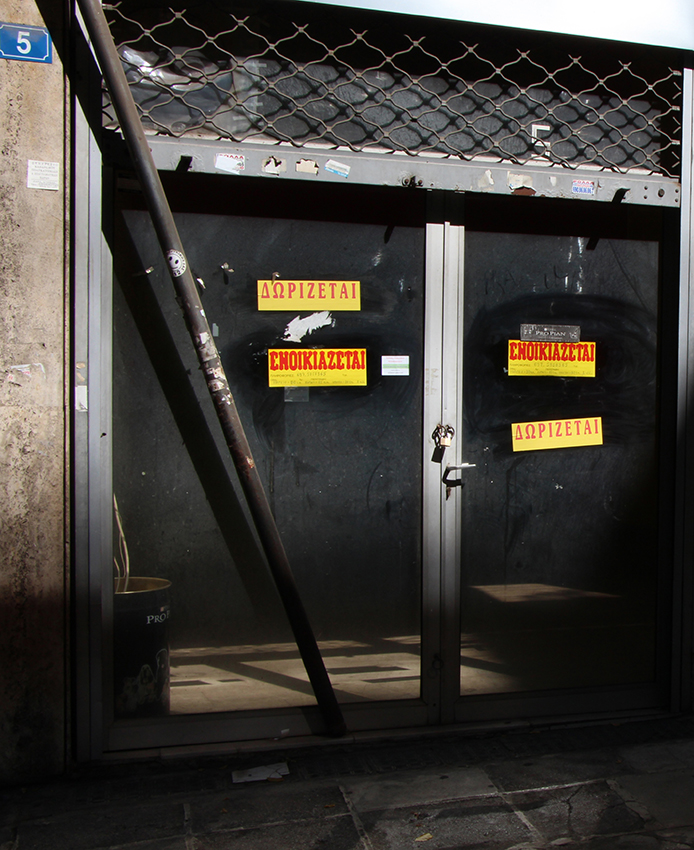
“ΔΩΡΙΖΕΤΑΙ” is a project made by Maaike Stutterheim, a dutch visual artist that graduated from the Gerrit Rietvelt Academy in Amsterdam. She came up with the idea of this artwork, during her two-month stay in Snehta Residency (Athens written backwards). Maaike has been visiting Greece (and specifically Athens and Leros) almost every year since the age of 4. Therefore, she has both the objective eye of a “foreign” artist and the attachment and sensitivity of a “local” one. This combination was pretty crucial for the making of the project. She wanted to make a work focussing on the juxtaposition of the growing amount of empty spaces, shops, houses buildings, and the growing amount of homeless and jobless people in Greece. Some weeks after our first meeting she asked me: “Do you see all these paste-ups saying FOR RENT and FOR SALE? They are everywhere. I want to create one that says FOR FREE.” At that point her research for the realization of the project started.
These signs have a specific form in Greece: They always have red typefaces printed on yellow paper, you can buy them in corner shops and kiosks for a couple of euros. She experimented with different sizes and papers in order to find the one that would speak exactly the same “language” as the ones in the street. This task was more complicated than it seemed but she managed to find the font and ordered 6500 “ΔΩΡΙΖΕΤΑΙ” signs. She started pasting them up in the streets systematically for more than three months. The artist tried to create a visual dialogue with the “FOR RENT” and “FOR SALE” signs and used them in many innovative ways and in a variety of places, using humor and imagination, pasting them in front of government buildings, beaches and so commenting on the political situation in Greece at the moment. However, she focused on glueing them in the window screens of the empty shops, that are getting more and more in the city centre due to the crisis. Maaike hopes that her project might create awareness over the use of all these empty spaces. She believes that people should think creatively and just do something with it and she keeps wondering why since there are so many homeless and unemployed people nobody is not occupying these empty shops. She gets somehow frustrated when she talks to people about it, since the majority of the counterarguments refer to bureaucratic obstacles. In addition, the reaction of the public to her project differs. Some people think that it is a humorous joke, others characterize it as an annoying/cynical prank and some (especially the owners) find it threatening and they remove the signs as soon as they notice them.)
We need here to stress that Maaike comes from a “different” background. In Holland there was a law (until recently), that legitimized the occupation/squatting of a building, if it has been empty for more than a year. On top of that she is a member of the Artists with Attitude (AWA), a curatorial initiative that was based in the cultural centre OT301, which used to be a squat in Amsterdam. In her artworks one encounters the idea of the re-use of empty spaces a lot. During the past years she creates installations/“environments” in abandoned hotels in Europe, using found objects that people left there These storytelling images reveal that the artist not only attempts to construct on nothingness, but also to extract life from the uninhabited.
[A text created by Vital Space Team in cooperation with Maaike Stutterheim]
By con@concept-pl.us in
on October 26th, 2019
Extra Muros an Installation & Event by Maria Papanikolaou. Athens (2011)
The title “extra muros” paraphrases the latin phrase “in muros”, that is mainly used to describe the life that we barely see and therefore acknowledge, namely the life beyond prison walls. Extra Muros is part of the art project “Apo-drasis”, which includes a series of fictional jailbreak stories. These stories are written by the artist and gradually come to be the springboard for the creation of sculptures, installations, photographs and videos. For the most part they focus on events & actions that challenge the architecture and construction of the prison cell, such as digging tunnels, cutting window bars, demolishing walls, etc. The installation “Extra Muros” is based on the fictional story below: 56 prisoners escaped from a rural chinese prison by breaking the walls literally with bare hands. At their surprise the construction material of the wall was easily erodible by vinegar, a liquid produced in quantity at the prison fields. For more than a year the prison inmates have been spraying vinegar at the same wall, so that it was gradually worn away and its thickness was reduced down to a few millimeters. At dawn on March 29 they finally managed to break the prison wall open and escape. More specifically the artist created a plaster wall based on the story and used it in order to block the main entrance of the exhibition venue. The wall was designed to be flimsy, incoherent and fragile. Its main feature was the see-through plaster surface. The plaster was at some spots very thin, nearly transparent. Since the entrance wall was darkened on purpose the visual result was that the first visitors were able to see fragments of light coming through the “wall”. The fragility of the wall created by the artist related to the prison wall of the fictional story the day it became fragile enough to be broken by the inmates. The visitors had to break the wall themselves in order to enter to the exhibition centre. The initial goal of the project above was to explore the visual representation of imprisonment and the prisoner in particular in the fine arts field. Since the prisoner is usually depicted as a helpless and passive victim in the majority of relevant artworks (especially paintings), the image of an empty cell is rather challenging. The artworks described above generate cell images where the human presence can only be implied by the action of breaking out. Therefore it presents a prison devoid of prisoners. In addition the prisoner is presented here as an active subject that defines its future and reconstructs the given space in order to gain his freedom back.The event took place at the: “Nikos Kessanlis” Exhibition Venue, Athens School of Fine Arts June-July 2011
Size: Variable
Material: Plaster
By con@concept-pl.us in
on October 26th, 2019
A project by Triada Samaras, 2012
What is the state of Greece today? The photographic series: The State of Greece 2012: ΕΝΟΙΚΙΑΖΕΤΑΙ – ΠΩΛΕΙΤΑΙ: FOR RENT – FOR SALE explores this question. As a Greek/American artist, I am deeply moved by the economic crisis and current economic realities in Greece. In a multitude of subtle and obvious ways, Greek economic austerity, as a theme, triumphs the Greek visual landscape in this moment. The words: ΕΝΟΙΚΙΑΖΕΤΑΙ – ΠΩΛΕΙΤΑΙ: FOR RENT – FOR SALE dominate the streets, structures and spaces of Greece, repeating themselves ad nauseam along blocks of once occupied homes and shops, spelling out the current, disastrous Greek state of affairs. It is impossible to ignore these signs, and their menacing forebodings. They point to a co-existent yet sometimes hidden stress, poverty, and lack of a clear future for Greece that are only too obvious to the people of Greece.
As an interdisciplinary and socially engaged artist, my work often grapples with contentious environmental, social, and economic issues in New York City. In addition to feeling an enormous compassion for the people of Greece, I cannot but help but notice the ominous similarities between the current Greek economic crisis and the less visually obvious one on American soil.
I took these photographs in Greece, 2012, to capture the spirit of the economic times in Greece by focusing on the city of Athens. Walking along the streets of central Athens, I photographed Syntagma Square, Stadiou Str, Hermou Str between Syntagma, and Omonia Squares, Monasteraki and Omonia Squares, and the neighborhoods of Pagkrati and Ilissia. I describe these routes and areas as anyone familiar with Athens will know they are neither the poor areas, nor are they off the beaten track, but rather they constitute the central, well traveled, and once affluent streets of former Athens. Today, however, things look very different. As art critic Susan Handler wrote about my work, “Utilizing the language of visual symbolism and the written word, the viewer can read in her photographs the toxic plague that is thriving and destroying the country.”
“It is my sincere hope that these photographs might provoke the viewer to ask questions and to seek creative solutions. To this end, I have created a Facebook page where the pubic can participate freely in the creative process regarding this issue at: Enoikiazetai-Poleitai-For-Rent-For-Sale. I invite everyone to join in this process.
The situation in Greece is not an exception. In fact, economic austerity and the principles of economic austerity are being recreated elsewhere, even in the United States, as this text is being written. No one is ultimately immune from these economic realities. In Greece we say, ELLADA PAEI (Greece goes). But where are Greece and the rest of the world going? It appears no one knows for sure.” Triada Samaras